Dr. Pablo Lozano Lominchar · Surgical oncologist · Madrid

Peritoneal carcinomatosis and sarcoma: specialist surgery and second opinions

If you or someone close to you has been diagnosed with cancer that has spread to the peritoneum — from the colon, ovary, stomach or appendix — with peritoneal mesothelioma or with a sarcoma, this is where to find what can be done, with the published results, and how to request a second opinion with your scans in hand.

  • CSUR for sarcoma · National reference centre
  • MSKCC fellowship, New York
  • Patients from all of Spain and abroad
  • Online consultation available
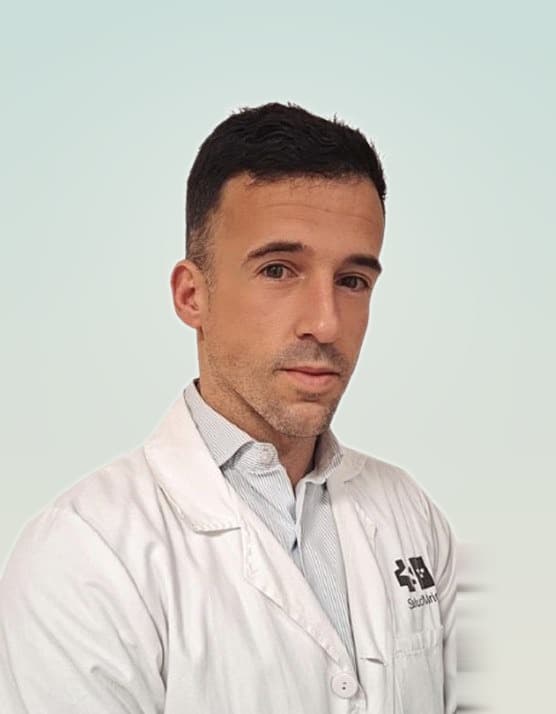
Portrait of Dr. Pablo Lozano Lominchar

Pablo Lozano Lominchar, MD, PhD, EBPSM

Peritoneal surface malignancy, sarcoma and complex pelvic surgery · Hospital Gregorio Marañón

Start from your diagnosis

What have you been diagnosed with?

Each page explains the disease in the patient's language, with published results and their sources, and ends by saying when a second opinion is worth seeking.

Second opinion

Three steps, and a clear answer

Seeking a second opinion is not a vote of no confidence. In peritoneal disease and sarcoma it is the reasonable thing to do: these are rare diseases and the team's experience changes the outcome. The answer may be yes to surgery, no, or that something is needed before deciding. All three are useful.

  1. 1

    Send the tests

    Imaging in digital form — the full study, not just the report — plus the pathology and the surgical and oncology reports, with dates.

  2. 2

    The case is reviewed in advance

    The documentation is studied before the visit, so the consultation is spent on decisions rather than on reading paperwork.

  3. 3

    In-person or online consultation

    With a concrete conclusion: whether surgery is indicated, whether it is not, or what is missing before deciding. Follow-up is coordinated with your own doctor.

Years in Peritoneal Carcinomatosis
15+
Publications in PubMed
60
Fellowship 2023–2024
MSKCC
National Reference Centre
CSUR

Clinical Expertise

High-complexity surgical oncology

01

Peritoneal Surface Malignancies

Comprehensive management of peritoneal carcinomatosis from colorectal, ovarian, gastric, and appendiceal origins using CRS+HIPEC. 15 years of experience in the first group for this disease founded in Madrid.

02

Retroperitoneal Sarcoma

Expert compartmental resection of retroperitoneal soft tissue sarcomas including WDLPS, DDLPS, and LMS. Complex multivisceral procedures.

Read about retroperitoneal sarcoma →
03

CRS + HIPEC

Cytoreductive surgery with hyperthermic intraperitoneal chemotherapy. 50–60 procedures per year at a high-volume centre.

The operation, step by step →
04

Complex Pelvic Surgery

Recurrent pelvic tumours, sacral chordoma, pelvic reconstruction. Multidisciplinary approach.

For patients

Clear information for patients and families

Peritoneal carcinomatosis, sarcoma, HIPEC, palliative surgery, recovery, and FAQs — explained in plain language.

Patient information

New · A book for patients

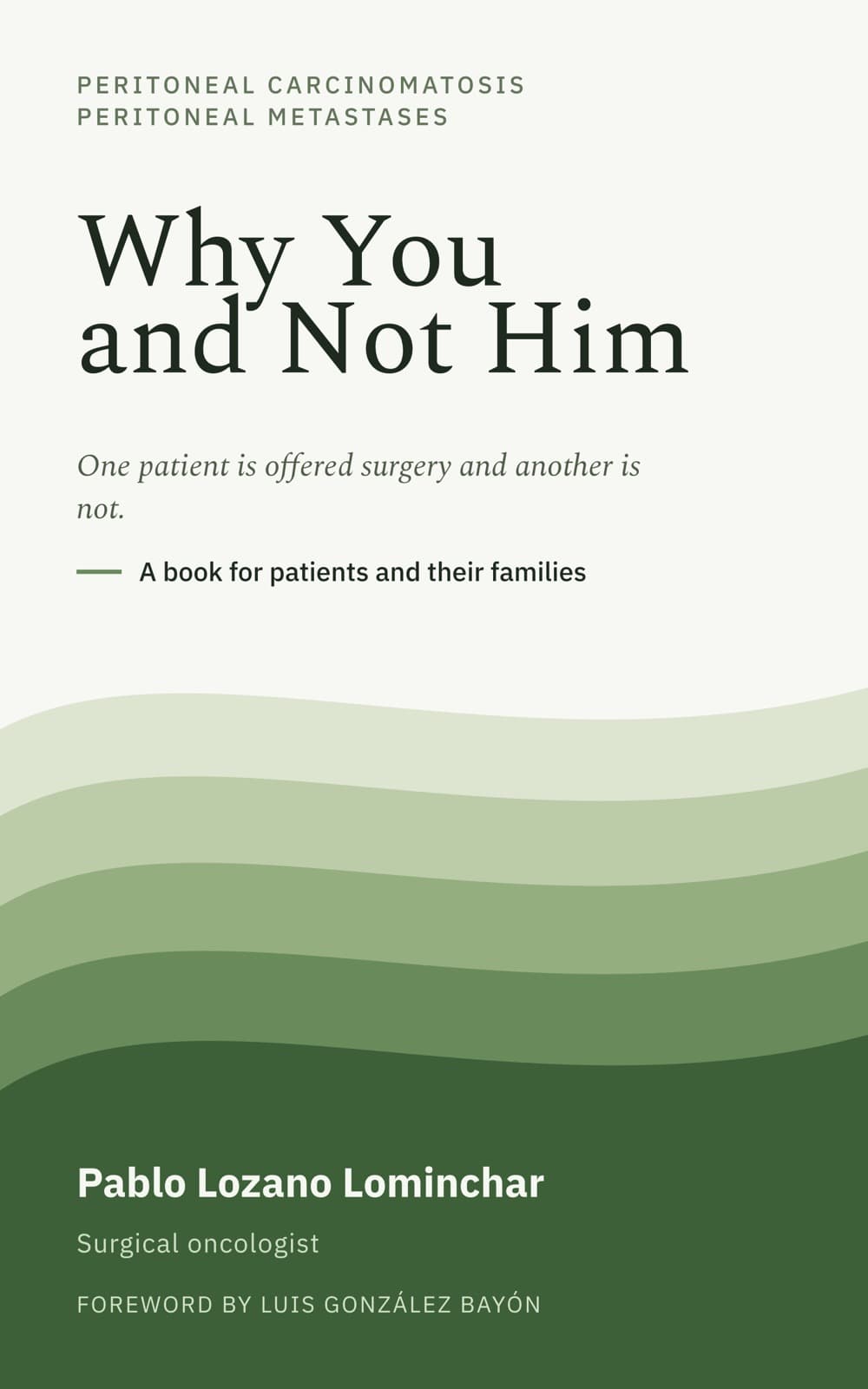
Why You and Not Him

Peritoneal carcinomatosis and peritoneal metastases: why one patient is offered surgery and another is not

Cover of Why You and Not Him, a book for patients with peritoneal carcinomatosis
Published 20 September 202681 pages · Kindle editionForeword by Luis González Bayón

You have been told you have peritoneal carcinomatosis. You searched online and found figures you could not place, from studies with no date on them. This book sorts them out.

In 2003, a patient with peritoneal metastases from colorectal cancer lived a median of twelve months. In 2021, the operable patients in the PRODIGE 7 trial were past forty. None of that existed when the person treating you began training.

Written without compassion and without euphemism, for an adult reader who does not know medicine but does know how to read. Every figure comes from a published study and carries its full citation at the back, so you can check it or take it to your doctor.

What is inside

  • What the peritoneum is, and why ordinary chemotherapy arrives there badly.
  • Colon, appendix, mesothelioma, ovary, stomach: one disease per chapter, with its figures.
  • What HIPEC and PIPAC are, and what they are not.
  • The risks, in real numbers.
  • What is being tested now, and what is still unknown.
  • The questions to take to your appointment.

This is not medical advice and does not replace your team. It exists to make the conversation with your doctor better.

International collaboration

A global network in peritoneal oncology

Peritoneal carcinomatosis is uncommon in any single centre. No hospital accrues enough cases on its own to answer the questions that matter, which is why this work is done as a network.

In July 2026, took part in Beijing in the programme behind the creation of the International Research Center for Peritoneal Surface Oncology (IRCPSO) at Tsinghua University, alongside teams from China, Japan, the Netherlands, Spain and India. The appointment as Distinguished Adjunct Expert of the centre followed.

People's Republic of China

International appointment · 2026

Distinguished Adjunct Expert

International Research Center for Peritoneal Surface Oncology (IRCPSO)

Beijing Tsinghua Changgung Hospital · Tsinghua University · Beijing, China

The IRCPSO is the centre Tsinghua University has created to bring together the world's research on peritoneal surface malignancy. The appointment means standing participation in its multicentre projects, registries and trials.

  • IRCPSO
  • BTCH
  • PSOGI
  • EURACAN
  • TARPSWG
  • MSKCC

Your experience

Leave a review or a comment

If you have been a patient, worked with me in theatre or on a tumour board, or taken one of the courses, I want to hear it: what worked, what did not, and what was missing. Everything gets read.

Nothing is published on this site. If a comment were ever to be quoted, permission would be asked for in writing first. Please do not include clinical details or other people's data.

For surgeons and residents

Teaching, the book and digital projects

My own project

SurgBoardsQ&A — preparing for the surgical board

A platform for preparing surgical certification exams: a bank of more than 10,000 questions, every answer explained and referenced to a guideline, an oral exam simulator that questions you back, and a study plan matched to the specific board you are sitting.

I write it myself, as a practising surgical oncologist — not a content agency. Every question comes out of practice and is referenced to NCCN, ESMO, ESSO, PSOGI or JGCA, so what is learned is the reasoning, not the key.

  • Filtered to your exact exam — ABS, FEBS, MCh, TCBC and others, every question mapped to the official syllabus.
  • Oral exam simulator: clinical cases presented step by step that probe further when you answer vaguely, just like a real viva, including critical appraisal of recent trials.
  • Weak-area tracking: the engine measures your accuracy and resurfaces the topics you keep missing.
  • Installs as an app on iPhone and Android and works offline. No app store needed.
Go to surgicalboardsqa.com

50-question free trial · no credit card · no auto-renewal

Explained questions
10,000+
Boards covered
15
Countries
6
Specialties
10

Surgical oncology, HPB, coloproctology, endocrine, breast, oesophagogastric, bariatric and transplant.

The book

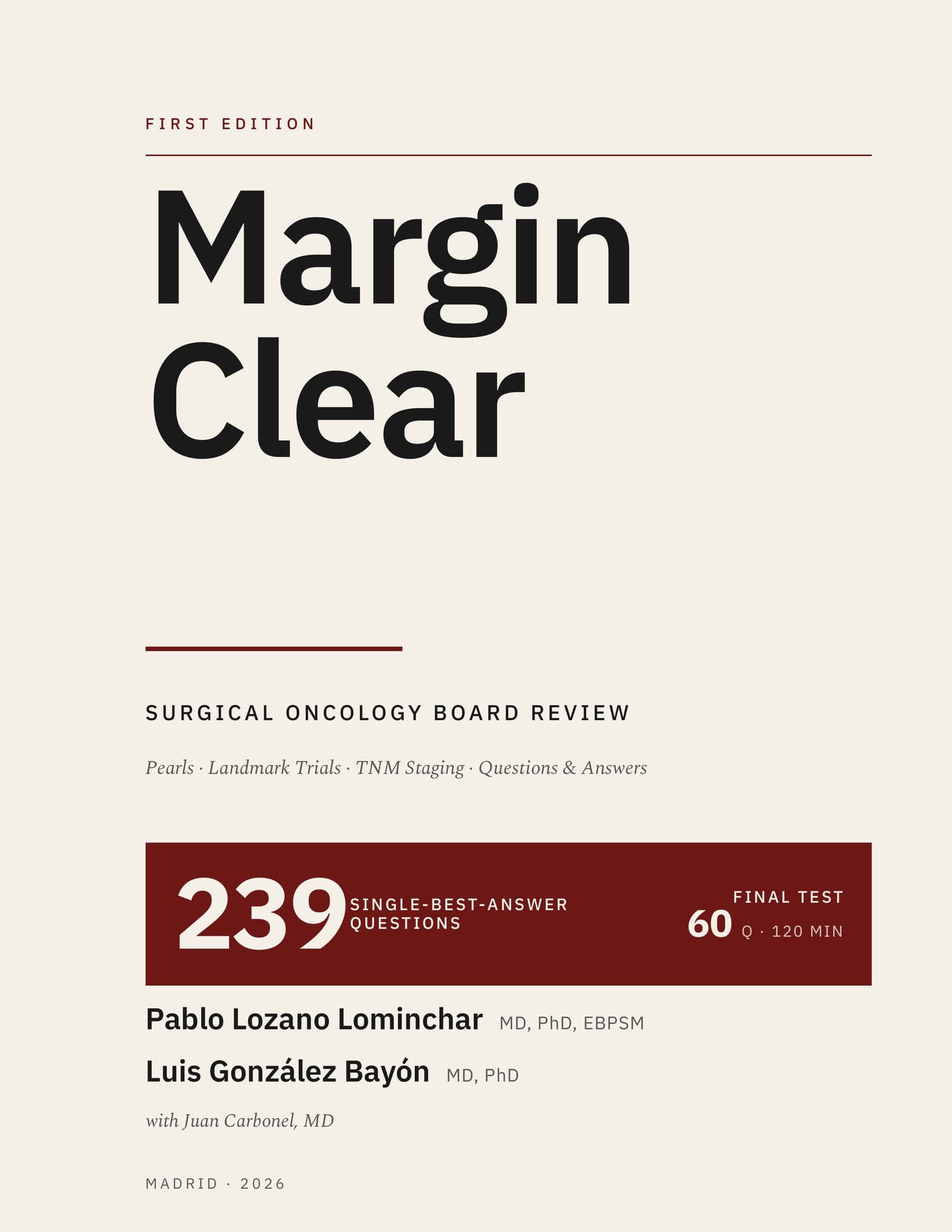
Margin Clear

Surgical Oncology Board Review

Cover of Margin Clear — Surgical Oncology Board Review, first edition
First edition · Madrid 2026574 pages · in EnglishPaperback out now

A board review manual for surgical oncology: exam pearls, the trials that changed practice, TNM staging and questions with commented answers, in a single volume.

It was not born in an office but at Memorial Sloan Kettering Cancer Center, operating on retroperitoneal sarcoma and peritoneal malignant disease, and was finished at Hospital Gregorio Marañón.

Authors

Pablo Lozano Lominchar, MD, PhD, EBPSM

Luis González Bayón, MD, PhD

With Juan Carbonell, MD

What is inside

  • Board pearls: what comes up in the exam and what residents forget.
  • Landmark trials: the studies that changed practice, distilled for decision-making.
  • TNM staging (AJCC 8th ed.) for the major tumours, in tables.
  • Questions and answers with commentary, not just the key.

574-page paperback (21.6 × 27.9 cm) and Kindle edition, both on Amazon.

Training & affiliations

MSKCCUCMCSURPSOGIESPSO

Have you been told nothing can be done?

In peritoneal disease and sarcoma, the criteria that rule surgery out are not those of other tumours. An honest review of the case can change the plan, or confirm it and put the doubt to rest.